
The feud between WordPress.org and WP Engines has taken a new turn after WP engine revised its initial complaint against WordPress.org, by accusing Mullenweg of Antitrust violation.
As per the recent updates of WordPress.org and WP Engine battle news; WP Engine has revised its complaint against CEO Matt and Automattic. In the revised legal complaint, WP Engines accused CEO Mullenweg and Automattic of Antitrust violation.
In previous complaint, filed on 2nd Oct. 2024, WP Engines has accused Automattic & Mullenweg of extortion, libel, abuse, etc.
A spokesperson told The register, “We have amended and expanded our initial complaint to include antitrust claims. It is designed to protect competition & consumers from the damage that a dominant player can inflict. As well as other new claims are arising from Mullenweg and Automattic’s continued pattern of misconduct.
WP Engine’s Amended complaint
The WP Engine’s amended complaint, which extended from 62 pages to 144 pages, states that, “While Defendants have continually made representations guaranteeing access to the WordPress open-source software and community. but they are now demanding 8 percent of WPE’s revenues for a purported trademark license to refer to ‘WordPress,’ a use for which no license is needed”
The amended complaint further reads “Defendants are using their purported trademark rights to block WPE from the WordPress community as a means to extort monopolistic pricing. This conduct demonstrates Defendants’ direct use of their trademarks to exclude competition and maintain a monopoly over the market, in violation of Section 2 of the Sherman Act, 15 U.S.C. § 2.”
“Defendants indisputably knew that Mullenweg personally owned WordPress.org, and that Automattic had been given an exclusive license and that the transfer to the [WordPress] Foundation was illusory, and that the ownership of WordPress.org and the exclusive license created a conflict of interest. Defendants also knew that contrary to their promises that WordPress would be ‘free’ and ‘open’ ‘to the world’ forever, Defendants could, at any time, begin making extortionate demands for ransom payments and ban anyone they unilaterally deemed to be a competitive threat.”
Automattic’s Reply to The Amended Complaint
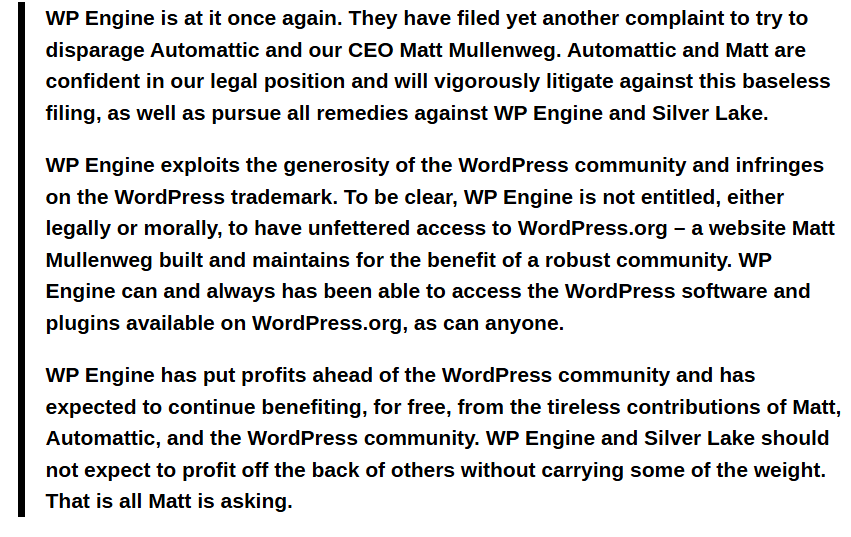
Image source: https://www.theregister.com/2024/11/15/wp_engine_antitrust_automattic_lawsuit/
