
WordPress has faced a decline in market share for the last six consecutive months. This decline is significant enough to raise a sharper question: is WordPress dying? And what does it mean for hosting providers?
According to W3Techs, WordPress is used by 58.9% of all websites with a known CMS, which equals 40.7% of all websites. The slide has been picking up speed: 1.3 percentage points disappeared between December 2025 and May 2026 alone, more than double the 0.6-point drop for all of 2025. That’s not noise. That’s a trend line bending the wrong way for the first time in the platform’s history.
WordPress Faces Noticeable Market Share Shifts
While the other platforms shown in the current W3Techs graph remain relatively stable or experience only modest gains or declines, WordPress stands out for the sharper fluctuations in its market share. The scale and pace of these changes suggest greater market share volatility compared with other leading platforms. Here’s a graph of WordPress market share from May 2025 to May 2026.
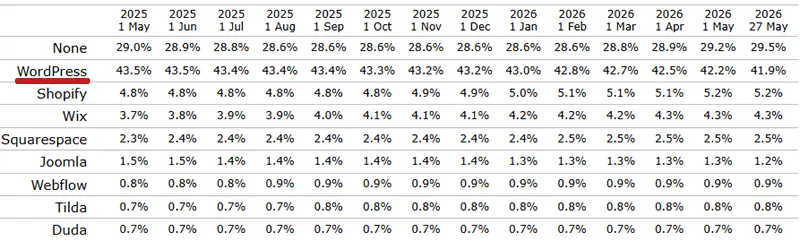
(Source: Search Engine Journal)
The Competitors Aren’t Gaining Ground
If the narratives about AI website builders and hosted platforms taking over WordPress were true, the gains would show up across those platforms. They largely don’t. Shopify picked up roughly four-tenths of a percentage point over the year; Wix about six-tenths, and Squarespace remained essentially flat. None of that comes close to accounting for what WordPress gave up.
The category that’s actually growing is the one that isn’t a platform at all: sites where no CMS is detected, static output, framework builds, and generated code served straight from a CDN. These aren’t WordPress sites that moved to a different dashboard. They are sites that skipped the dashboard entirely.
That’s the real story behind the AI angle, and it’s not the one usually reported. It isn’t just about prompting and getting a website ready. It’s that building something genuinely custom has become inexpensive enough that a category of projects that used to default to WordPress no longer has to. A brochure site that would have been a theme plus page builder in 2022 can now be a weekend static build.
Why Should Hosting Providers Pay Attention?
This shift matters to hosting providers because traditional shared hosting depends on clients needing PHP and MySQL, along with services such as backups, staging, and caching. A static website hosted behind a CDN may not require most of these services.
WordPress is not disappearing. It still powers 58.9% of websites that use a CMS, which is more than the next nine platforms combined. Its large user base is not going away overnight. However, hosting providers should pay attention to customers who once chose WordPress hosting by default but may now be considering simpler alternatives. The bigger risk is not losing customers to another hosting provider but losing them from the traditional hosting category altogether.
Security Risks Are Also a Concern for Hosting Providers
Patchstack’s 2026 report gives hosts a second, sharper argument, and it’s a security one. The WordPress ecosystem logged 11,334 new vulnerabilities in 2025, up 42% from 7,966 the year before. Only six of those vulnerabilities were in WordPress core. Plugins accounted for 91%. Speed is the number that should worry about site owners more than volume.
Roughly half of high-impact vulnerabilities are exploited within 24 hours of disclosure, and for the most heavily targeted flaws, Patchstack’s weighted median time to first exploit is five hours. Worse, 46% of last year’s disclosed vulnerabilities went public before the plugin developer had shipped a fix. Five hours doesn’t leave room for a customer’s own patching schedule to matter. Protection has to sit at the platform level and be live before the site owner even hears about the flaw, which is exactly the pitch managed WordPress hosting has been making for years, now backed by starker numbers than before.
What’s Actually Ending
WordPress running 40.7% of the entire web is still a bigger footprint than any other platform can currently reach. What’s changing isn’t WordPress’s floor; it’s whether it’s still the default nobody thinks twice about. Increasingly, it’s a deliberate choice: the right call when a client needs to update their own content for years without touching a developer, and a less obvious choice when the project is custom-built or performance-first.
For hosting providers, that means the WordPress book of business holds, but it stops growing on autopilot. The customers worth keeping are staying for real reasons: ease of editing, the plugin ecosystem, and a workflow their team already knows. The ones leaving were never going to be retained by a better renewal email.
